Climate Change Seen on Mount Everest
- Narendra Shahi Thakuri, President Gandaki Alpine Club
 I started climbing big mountains in 2009. My first mountain climb was Mount Manaslu. After that, I tried Mt. Everest for the first time in 2015 in the mountains of Eastern Nepal. But at that time I could not succeed due to the earthquake. I climbed Everest for the first time in 2017.
Then I climbed in 2018 as well. I did not go to Everest in 2019 and 2020. I couldn’t reach the summit in 2021 due to Covid-19. I reached camp-3 and returned. Now, in 2022, I was able to kiss the summit of Everest again. In this way, I saw various changes directly during this interval of going to Mt. Everest several times.
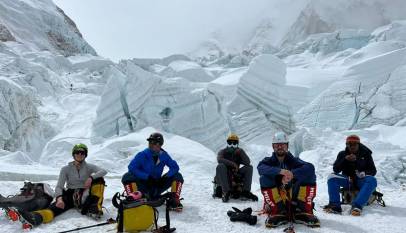
This gave me the feeling that rapid changes are taking place on the highest peak, Mt. Everest. In 2015, the vertical ice sections at Everest Base Camp and Khumbu Icefall were very high. Some were up to 50 meters high. There was technical ice climbing in such places.
Now it is reduced to only 15-20 meters. Technical ice climbing is still practiced by Nepali and foreign climbers before going to the summit. Talking about the base camp itself, the coldness, glacier structure, and snow layer that was there before is gradually decreasing.
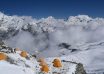
Now sometimes there is a feeling of an environment of Kathmandu in the base camp. Now it was possible to walk in normal clothes in the afternoon sun which was not possible before. Speaking of Khumbu Icefall itself, I have seen a lot of changes since 2017.
At that time, there were 4/5 places where ladders had to be climbed, but in 2022, I saw only two ladders there. According to our elders, before 2015, they had to climb the crevasses by keeping up to 7/8 horizontal ladders. It is said that after climbing 7/8 ladders, instead of walking normally, they were bound to go crawling. But now it is not so.
The flatness of Camp-1 is also gradually narrowing. The reason for the decrease in the flatness of Camp-1 is the decrease of the Khumbu Icefall every year.

Even on the way from Camp-1 to Camp-2, more changes have appeared than before. Earlier, there were many crevasses and vertical sections but now it has decreased. This time there were only two ladders on that road. Before that, 4/5 ladders would have been kept in place.
The hanging ice of the Nupche site, as well as the hanging ice of another site, is also decreasing. Even if you go from Camp-2 to Camp-3, you will find slushy snow. Slushy snow is when the snow melts too much in the afternoon sun and becomes slippery.
While it is easier to walk on frozen snow, it is more difficult to walk on slushy snow. This slushy snow is up to Camp-3. Due to slushy snow, the vertical section is acceptable but the horizontal sections are difficult.
The section from Camp-2 to Lhotse foothills is difficult due to slushy snow. Also, after reaching Camp-2, changes can be seen directly. Earlier, water could be seen there after the snow melted a little in the afternoon sun, but now it flows like a river.
A river flowing at a height of 6,400 meters is an example of how global warming is bringing changes to the 8,000-meter-high mountains. As the ice formations are decreasing compared to before, more rock is seen in the rocky parts.

When talking about the side of the summit, it is difficult to walk because there is a lot of rock towards the Hillary Step. After attaching crampons to our boots, it is difficult to walk on the rock. New climbers who are not used to walking on rocks with crampons will find it very difficult in the Hillary Step area.
Even if there is a fixed rope, there is a big difference between walking in the snow with crampons and walking on rocky parts. It is more difficult for new climbers than for professional climbers like us.

Permanent snowfall continues decreasing in the mountains. That’s why a lot of rock sections are coming out in the base camp of Everest. Because of this, it is necessary to know about rock climbing. Not all climbers are good at rock climbing.
There are many rocky sections in the Labuche Himal in the Everest region. If it is on glaciers or blue ice, we make anchors using ice screws. If the rocky sections are there, they should be bolted with a drill machine.
Otherwise, anchors should be made using camming devices which are expensive. You have to take a rock pounder and hit it. When this changes every year, it becomes a challenge for the climbers. For example, when we go for the first year, we are using snow bars, and ice screws, and this year we will prepare the same, but if only the Rocky section is seen, it will not work.
If that doesn’t work, you have to use other extra equipment. For that, you have to use rock piton and camming devices. Mountain climbing will become more challenging in the future as more rocky sections are seen.
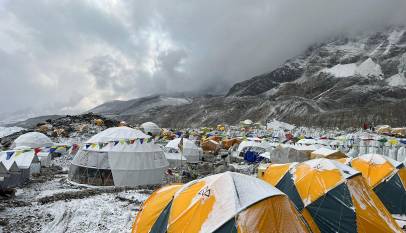
On the one hand, global warming is taking place; similarly, the kind of crowd in the Everest base camp during the spring season has also had a huge impact. For example, every team is managing their base camp by removing permanent snow. Our elders are saying that the Wes Camp has gone down much lower than before.

I have felt that. It seems that in the next 30-40 years there will be a very small base camp. Permanent snow takes many years to form. In this way, if the rate of snow formation decreases and the rate of melting increases, it will lead to more erosion of this area.
There is a lot of natural snow melting now, and the kind of crowd at the base camp has affected it a lot. For example, for the construction of camps, it is necessary to maintain steep slopes and many people are using water, hot water. The water after taking a shower is going to the ice. If the hot water goes a little in the cold, it affects a lot.
Mustang as international tourist destination
Luring Mustang as one of the top tourist destinations in Nepal involves highlighting its u…
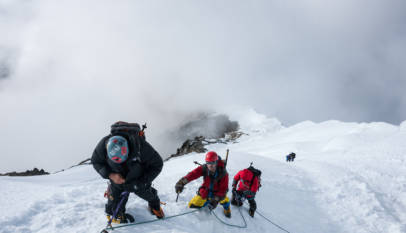
NMA Introduces Revised Curriculum for Professional Mountaineering Training
Kathmandu: The Nepal Mountaineering Association (NMA) has introduced a revised curriculum for its Professional …